

Will Pakistan reach it’s 2030 Emission Goal?
Pakistan’s Environmental Landscape
Pakistan is a developing country that faces challenges in balancing economic growth and development with environmental sustainability. It has a rapidly growing population and economy, increasing demands for energy and resources. Major sources of carbon emissions in Pakistan include the energy sector, transportation, agriculture and waste. Coal power plants are a big contributor, providing about 37% of Pakistan’s electricity. Vehicle emissions are increasing in urban areas due to a growing number of cars and motorcycles. Deforestation is a significant issue, with Pakistan losing forest cover rapidly due to logging and clearing land for agriculture. This contributes to climate change and reduces carbon sequestration.
Even though Pakistan is not a significant contributor to global warming (as seen in my previous paper), it is on a high-growth trajectory of carbon emissions due to heavy reliance on fossil fuels. This calls for large scale long-term decarbonization efforts in the country.
Pakistan’s Climate Pledge
In 2016, Pakistan officially became one of 194 signatories (100 at the time) to the Paris Agreement, which is considered the most significant global climate agreement to date. As a commitment to keep global warming to no more than 1.5°C, all signatories are called to reach net-zero carbon emissions by 2050 (which means greenhouse gases emitted should equate carbon removed from the atmosphere).
As part of the pledge, each country sets emissions-reduction targets and discloses its climate-action plan as its nationally determined contributions (NDCs) (UNFCC, 2021). In 2021, Pakistan shared the following target:
The Government of Pakistan (GoP) has ambitious plans for reducing its 2030 greenhouse gas (GHG) emissions to 50% of the 2016 baseline projected levels. Pakistan expects its annual emissions to reach 1.6bn MtCO2e by 2030. (If it meets its climate targets, its emissions will instead grow to 801 MtCO2e.)
The end of the most recent COP28 held in the United Arab Emirates closed with a historic agreement to transition away from climate change’s main culprit: fossil fuels and reach the goal of limiting global warming to 1.5°C above pre-industrial levels.
In this paper, I will use Machine Learning to predict whether Pakistan will reach its aforementioned climate targets using historical data. The purpose of this model is to forecast Pakistan’s GHG emissions given the available variables in the dataset over the next 10 years. This model will allow the policy-makers to quantify progress in decarbonization at the country level and drive near-term carbon abatement initiatives, such as switch to cleaner energy alternatives, subsidize zero-emission/ electric vehicles to name a few.
Model Data
To conduct this analysis, I will be using the World Development Indicators dataset obtained from the World Bank containing over a thousand annual indicators of economic development compiled from officially-recognized regional sources.
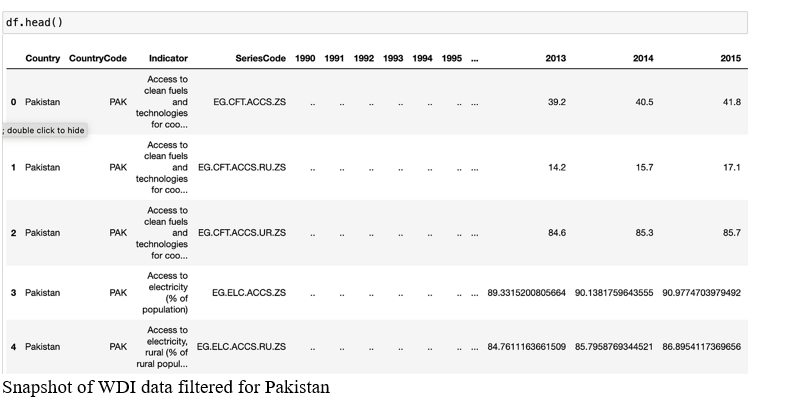
The data is available here: https://data.worldbank.org/indicator.
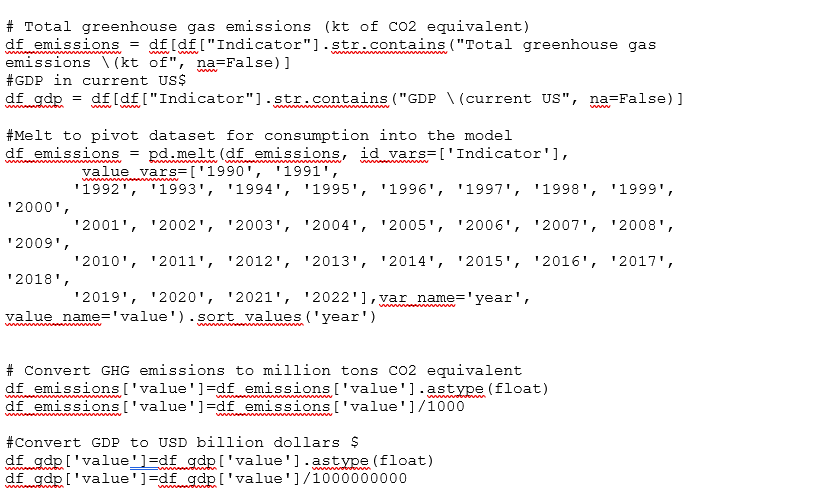
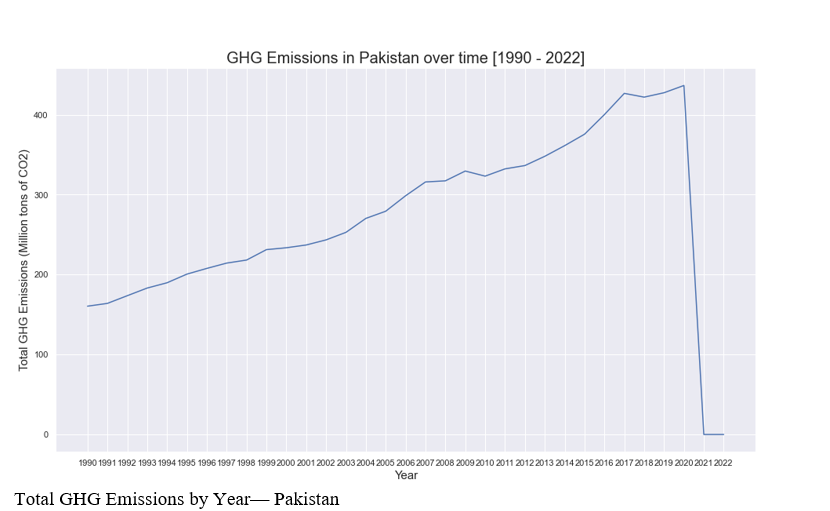
I analyzed 1486 non-null indicators from 1990–2022 and the emissions metric used for this analysis is Total greenhouse gas emissions in kt of CO2 equivalent and for economic growth, I selected GDP (current US$) — Pakistan which is defined as the sum of gross value added by all resident producers in the economy plus any product taxes and minus any subsidies not included in the value of the products (Source: World Bank).
Forecasting
Time series forecasting is a common data science tool that involves using statistical and machine learning techniques to analyze historical data and other factors that may affect forecasting a future trajectory, such as market effects or seasonal trends. Here, I will employ two techniques 1) Simple Regression and 2) ARIMA to calculate if Pakistan will reach it’s aforementioned emission target by 2030 of 801 MtCO2e?
Linear Regression
To start off, I built a simple linear regression model which provides a basic starting point for developing a GHG forecasting model tailored to Pakistan’s national circumstances. This provides a simple visualization of the model’s 2030 projected emission level along with the historical data. The plot can be updated as we refine the model and get closer to the target year.
However, the actual trajectory depends on many complex factors like economic and population growth, energy mix, climate policies and technological development.
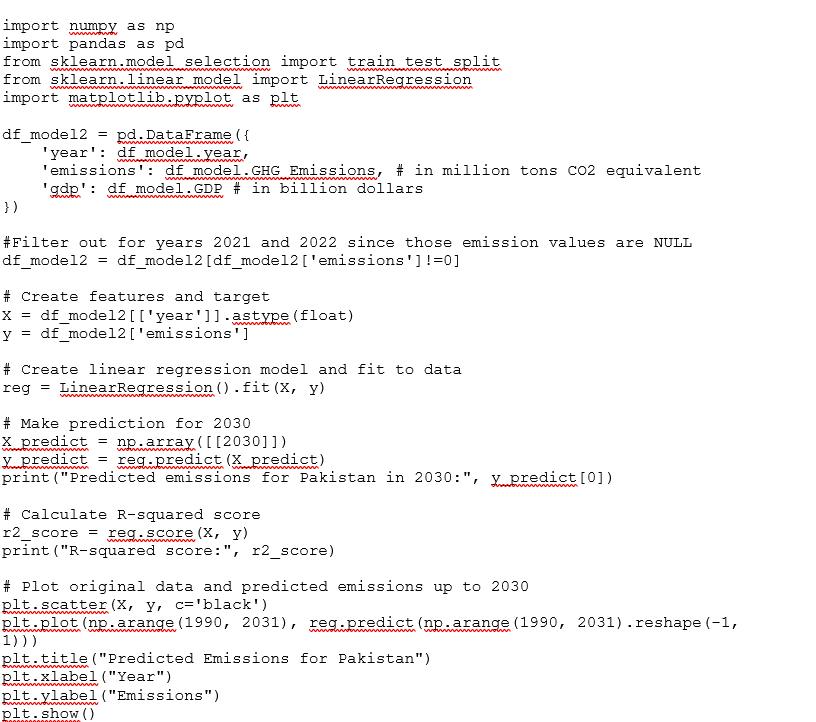
The following plot shows the historical emissions from 1990 to 2020 as a blue line plot. It then adds a red line with predicted emission values until 2030.
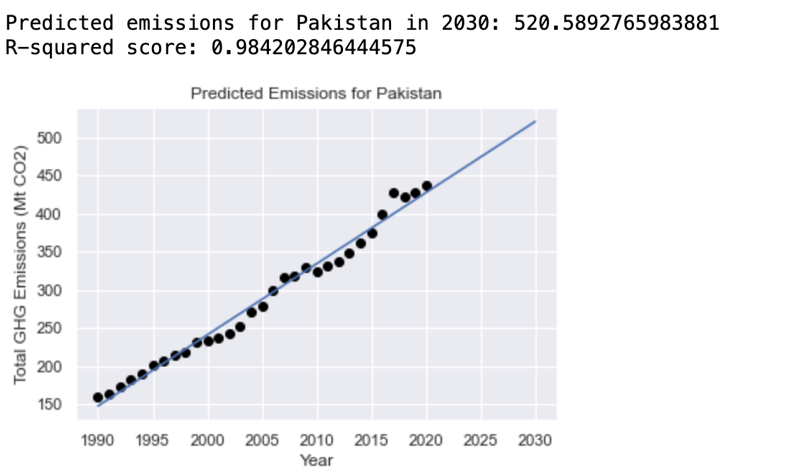
Linear Regression Model with High Accuracy
This predicts that Pakistan’s emissions continue rising steadily to reach ~521 Mt CO2 in 2030, which is lower than the target of 801 Mt CO2.
ARIMA
In this section, I will focus on ARIMA (Autoregressive Integrated Moving Average), which is one of the most widely used statistical models for analyzing and forecasting time series data. ARIMA is more flexible yet a robust approach for modeling trends, seasonality, cycles and randomness in time series when a large historical dataset is available. ARIMA has three components as follows:
- p — Specifies the order of time lag.
- d — Specifies the degree of differencing
- q — Specifies order of moving average.
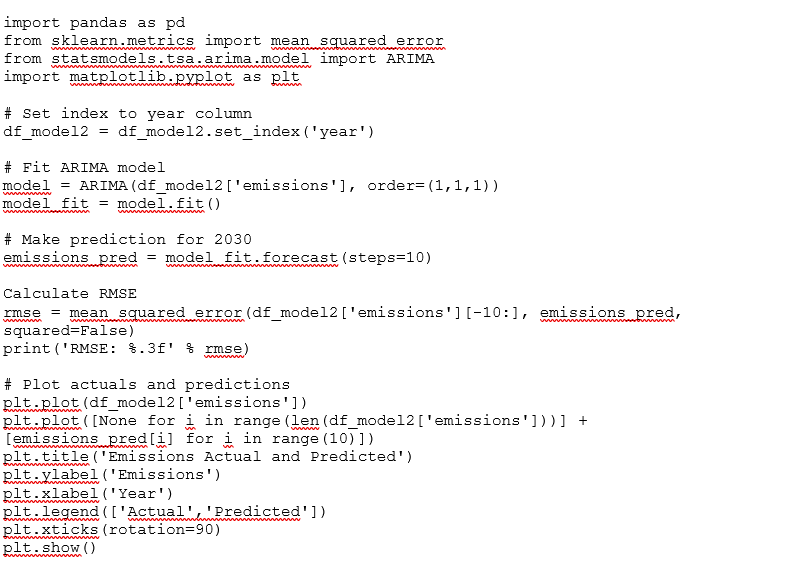
For the simplicity of this exercise, we assumed 1,1,1 for all three components. The model was fitted on historical emissions data. The model made multi-step ahead predictions based on projected emission, however, the RMSE ~ 100 which indicates that the model fits the data well.
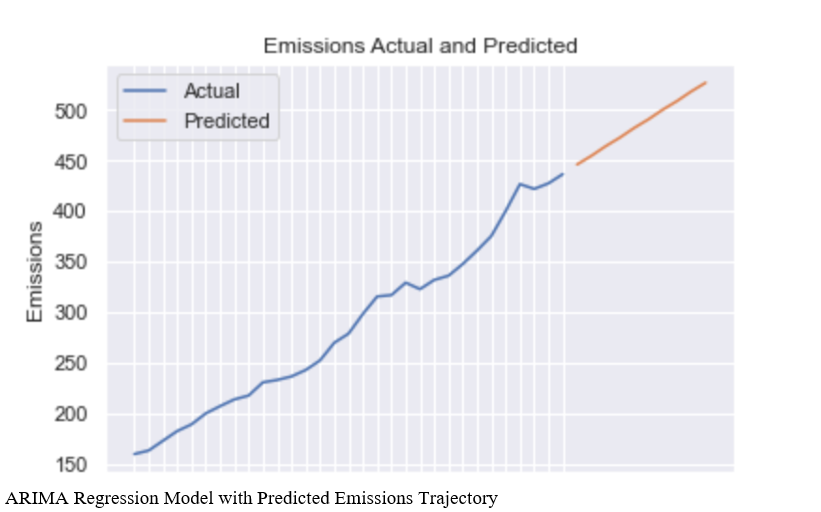
This model predicts that Pakistan’s emissions continue rising linearly to reach ~508.72 Mt CO2 in 2030, which is lower than the target of 801 Mt CO2.
Recommendations
To keep pacing towards the emission target for 2030, robust greenhouse gas emission data is crucial for Pakistan to make informed climate policies and meet global reporting obligations.
However, currently Pakistan lacks a systematic mechanism for monitoring, reporting and verifying emissions across sectors. The country needs to establish national inventory systems to accurately track emissions from energy, transport, industry, agriculture and land use. This requires strengthening institutions like the Pakistan Environmental Protection Agency to coordinate data collection according to IPCC guidelines.
Comprehensive activity data across sectors should be compiled and emission factors tailored for local conditions need to be developed. Pakistan also needs to build technical capacity in emission modeling and ensure regular national communication and biennial update reports to the UNFCCC. High-quality emission data will allow Pakistan to identify major sources of emissions, set precise reduction targets and monitor progress.
With improved data, Pakistan can also justify climate financing needs to the international community. Investing in rigorous emission documentation will help Pakistan make a fair contribution to global climate action and effectively transition towards a low-carbon economy.
References:
UNFCC, 2021: Pakistan NDC. https://unfccc.int/sites/default/files/NDC/2022-06/Pakistan%20Updated%20NDC%202021.pdf

