
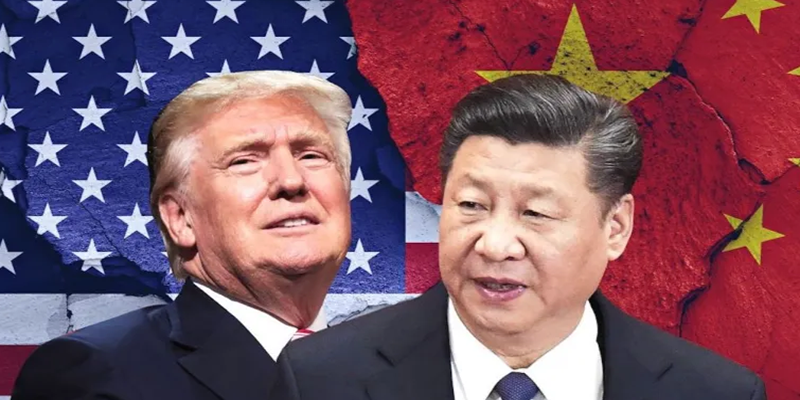
History lingers, but its influences do not necessarily reproduce the same results. We live in a world where victims of persecution themselves become oppressors, which is what has happening with Israel. Elsewhere, states which once tried to steer clear from Cold War camps have now become enthusiastic proponents of security and economic mechanisms wherein great power competition between China and the US is unfolding. The case of India provides an ideal example of the latter phenomenon.
Unlike Pakistan, which hastily signed on to US-led Cold War alliances in the 1950s and 1960s, India under Nehru’s leadership managed to craft a more nuanced foreign policy of non-alignment. While a stern pragmatist when it came to dealing with India’s internal troubles, Nehru did manage to balance relations with the US and the Soviet Union, even if he could not resolve India’s territorial differences with China amicably. In turn, Communist China decided to forge a seemingly unnatural alliance with the Islamic Republic of Pakistan, compelled by the logic of an enemy’s enemy being a friend.
Pakistan did not get significant American support during its repeated clashes with India, but it did manage to cash in on the Soviet invasion of Afghanistan. Fearing the possibility of a Soviet incursion push to gain access to the warm waters of the Arabian sea and motivated by the opportunity of becoming a key American ally, Pakistan under General Zia began to support the Afghan jihad. With Saudi and American support, Pakistan managed to militarize madrassa education to create ‘holy warriors’ willing to join the fight against the Soviet ‘infidels’. The newly minted mujahideen also lent a hand to the Kashmiri insurgency in India due to which the sectarian violence unleashed by them in Pakistan itself remained largely ignored.
Once the Soviets withdrew from Afghanistan, the US also lost interest in the region even as Afghanistan became embroiled in a bloody civil war, and Pakistan was left to deal with the heroin, Kalashnikov, and growing extremism menace at home. All eyes turned back to the region, however, when India, and then Pakistan, decided to overtly become nuclearized in 1998.
The US initially showed equal disdain for both India and Pakistan having detonated nuclear weapons, and it also sanctioned both countries temporarily. However, with the Clinton administration in power, beholden as it was to corporate interests, the value of a burgeoning Indian market could no longer be ignored. Meanwhile, economic stagnation had also led India to set aside its socialist aspirations, and it commenced a structural adjustment program which liberalized its economy to welcome big business giants such as Monsanto to make inroads into the Indian market. India has, no doubt, accomplished impressive growth, even though this growth is accompanied by a dark underbelly of deprivation and divisiveness along ethnic and religious lines.
The increasing ultranationalism of the BJP government has created some international discomfort, especially for human rights watchers. However, the American establishment has shied away from openly criticizing the Indian governments’ intolerance. For the US, support to India is also motivated by the desire to contain Chinese influence in South Asia and even in the pacific, which is why India has been pulled into the American-led quad alliance, alongside Australia and Japan. Given India’s strategic value, the Modi government has been given international platforms to extoll the virtues of democracy even though Indian Muslims are under serious threat and any civil dissent can be ruthlessly crushed. India even managed to host a G20 panel in Kashmir, and it has just managed to bring in the African Union as a member of the G20, which is being hailed by some as a rival bloc to China’s Brick and Road Initiative.
On the other hand, America’s relationship with Pakistan became quite a roller coaster ride since the turn of this century. American discomfort with another military regime coming to the fore in the country, led by General Musharraf, soon gave way to more practical considerations. The US needed Pakistani logistical and intelligence support to invade Afghanistan after 9/11, this time to flush out the jihadis it had helped train and finance during the 1980s. As Pakistan became a frontline state in the war on terror, it again became the recipient of American largess. The US was not happy to learn of nuclear proliferation linked to the father of the Pakistani nuclear bomb. While the Pakistani state did significantly improve its command-and-control structures to safeguard its nuclear assets, the US only inked a civilian nuclear cooperation agreement with India. Pakistan also became the subject of constant criticism by the US backed Afghan government, which also developed close ties with India. Pakistan, in part felt upset for America’s obliviousness to Pakistani regional insecurities, and for constantly being pressured to do more against the Taliban.
Pakistan had to pay a high price for its role in ‘the war on terror’. Its tribal areas were regularly targeted by drone strikes and there was an evident spike in extremist violence unleashed around the country by the Pakistani version of the Taliban, who aspired to target the Pakistani state in the same manner that their brethren were fighting the Americans and the Afghan government next door. Pakistan was partly embarrassed and partly felt let down when the US used the cover of a vaccination campaign to confirm the presence of Osama Bin Laden in Abbottabad, and then launch a raid to kill him, without Pakistani permission in 2011. Nonetheless, Pakistan persevered in its relations with the Taliban next door, and it thus managed to bring the Taliban to the negotiating table with the US, which was desperate to exit Afghanistan after its twenty-year embroilment that had produced lackluster results.
Setting aside Pakistani and American blame shifting about why the Taliban have returned to power in Afghanistan, it is not surprising that the US is even less interested in Pakistan now that it no longer has a military presence in the neighborhood. While intelligence cooperation between the two countries has continued, the anti-American sentiments whipped up in Pakistan by the deposed Imran Khan government have not yet subsided. America is presently watching what shape the political setup will take within the country after the current caretaker setup transits into an elected government.
While its relationship with the US was becoming strained, Pakistan bolstered its military and economic ties with China. In part, Pakistan’s growing reliance on China was indicative of its diminishing relationship with the US. While the much-lauded China Pakistan Economic Corridor has yet to become a flagship project of the BRI, it brought it billions of dollars into the country for much needed energy generation and infrastructure development, and that too at a time when the neither the US nor other foreign investors were willing to take a chance on the Pakistani economy. However, Pakistan is now heavily indebted to China which has thus far been gracious enough to keep rescheduling the payments it is owed. Nonetheless, the Pakistani economy is in significant distress and the US does fear that China will be able to use debt diplomacy to turn CPEC investments, especially the Gwadar port, into a dual use facility to further project Chinese naval presence. The Pakistani establishment has been reiterating that it does not want to put all its eggs in the Chinese basket, but besides some support from its traditional Gulf allies, it does not have many other options for desperately needed foreign investments.
Meanwhile, India is also having a tough time managing its growing relationship with the US while preserving its longstanding ties with Russia. India is also uncomfortable to note China and Russia having forged closer ties, especially after the international ostracization of Russia following the Ukraine crisis. Both China and India opted to skip the Indian hosted G20 summit, and China is not pleased with India’s maneuver to include the African Union in the G20. Whether this latest attempt to bypass the BRI will succeed remains to be seen. Earlier US attempts such as the Build Back Better initiative have seen little progress, especially compared to the evident Chinese footprint across numerous South Asian, Middle Eastern, and South Asian states.
While China’s economy is experiencing its own problems, India is nowhere near being able to compete with China, even with growing American support. There is no need for China and India to lock horns in the subcontinent, as doing so will also compel Pakistan to spend more on defense, which the country is currently in no position to afford. It would be wiser for both India and Pakistan to lean on the side of multilateralism, be it by continuing to focus on other trading blocs like the expanded BRICS grouping, or via Pakistan inviting American investors to explore emergent opportunities made possible by Chinese investments in the country, such as its newly created economic zones. The US cannot use its old playbook to degrade China via proxy warfare, given the fact that its own economy is inextricably linked with that of China.
Instead of trying to decouple technologies, create alternative economic cooperation projects to outbid each other, and use proxy states which are already struggling with their own internal pressures to engage in counter-productive strategic upmanship, it would be much better for the US to try and cooperate with China. While the world is much too complex now for the US to attempt another Pakistan facilitated Nixonian détente, the US can still leverage its significant influence with Pakistan to pilot-test cooperation with China.

